Do You Really Need a Self-Propelled Lawn Mower? Best Options for Different Lawn Sizes and Strength Levels

More than 60% of U.S. households have their own lawns, and one of the most debated questions when buying an electric mower is: “Should I choose a self-propelled or push mower?”
Some homeowners believe self-propelled models are an unnecessary expense, while others find pushing a mower exhausting—especially on larger lawns or mild slopes. According to Outdoor Power Equipment Institute (OPEI) 2024 survey data, 45% of consumers underestimate the physical effort required when choosing a lawn mower. Among those with limited physical strength, 70% end up replacing their mower within the first year.
The main advantage of a self-propelled lawn mower is reduced pushing force, but it’s not always the best choice for everyone. For small, flat lawns and people with strong physical ability, a lightweight push mower can be more agile. For larger lawns or those with limited mobility, self-propelled models can be a game changer.
This guide breaks down the real differences between push and self-propelled lawn mowers, analyzes how lawn size and physical strength affect your choice, and gives specific recommendations to help you avoid wasting money—or injuring your back.
Key Differences: Self-Propelled vs. Push Lawn Mowers
Many people think the only difference is “you don’t have to push as hard.” In fact, the differences extend to physical effort, suitable scenarios, and maneuverability, all of which affect whether a self-propelled mower is necessary for you.
Physical Effort: Self-Propelled Reduces Up to 70% of Pushing Force
A traditional push lawn mower relies entirely on human power to move forward. With an average weight of 30–50 lbs plus cutting resistance, this can be physically demanding.
For example, mowing a 1,000 sq. ft. lawn with a push mower typically requires about 30 minutes of moderate exertion. A self-propelled mower uses a built-in motor to drive the wheels, allowing users to simply guide the handle. This reduces pushing force by around 70%, cutting energy expenditure to about one-third of a push mower.
OPEI Lab Test:
Push mower: 15–20 lbs of push force per minute
Self-propelled mower: 5–8 lbs (similar to pushing a shopping cart)
This difference becomes more noticeable as lawn size increases or during longer mowing sessions.
Suitable Scenarios: Lawn Size and Slope Matter
Small flat lawns (≤500 sq. ft.): Push mowers are easier to maneuver around obstacles like trees or planters. They’re also lighter and easier to store.
Medium to large lawns (≥1,000 sq. ft.): Self-propelled mowers are more efficient. With a push mower, fatigue builds up quickly, often leading to uneven cutting.
Sloped lawns (≥15°): A self-propelled mower—especially rear-wheel or all-wheel drive—is much safer. Push mowers can slip backward or require dangerous levels of force on inclines.
Cost and Maintenance: Price Gap Is Narrowing
Self-propelled mowers used to cost $100–$200 more than push models. Today, the gap has narrowed to $50–$150.
For example, a Ryobi 40V cordless push mower costs around $299, while the self-propelled version of the same model is around $349.
Maintenance is minimal. Although self-propelled units have an extra drive motor and speed control lever, their failure rate is only about 5% higher than push mowers. Most brands include a two-year warranty, and regular cleaning of the drive wheels is usually enough to keep them running smoothly.
Choosing Based on Physical Strength and Lawn Conditions
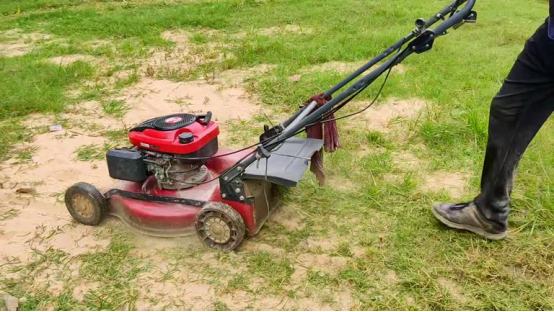
Whether self-propelled is necessary depends on the match between your physical ability and your lawn size/terrain. Below are three common user profiles with tailored recommendations.
1. High Physical Strength (Ages 18–35, active, no joint issues): Push Mower Is Sufficient
Ideal scenario:
Small, flat lawns (≤800 sq. ft.)
Frequent turns or obstacles
Users who can comfortably push moderate weight
Why push mowers work:
They’re lighter, cheaper, and more responsive to immediate direction changes. For active homeowners, the extra effort is manageable, and maneuverability is better than with a self-propelled unit.
Recommended Models:
Ryobi 40V Cordless Push Lawn Mower – approx. $299, 35 lbs, 45-min runtime, great for small suburban yards.
Greenworks 20-inch Corded Push Mower – approx. $199, unlimited runtime with power outlet, budget-friendly.
If lawn size exceeds 1,000 sq. ft., consider upgrading to a lightweight self-propelled mower such as EGO Power+ 21-inch Self-Propelled Lawn Mower to prevent strain injuries over time.
2. Moderate Physical Strength (Ages 36–55, occasional back or joint discomfort): Front-Wheel Self-Propelled Is Best
Ideal scenario:
Medium lawns (800–2,000 sq. ft.)
Gentle slopes (≤10°)
Once-a-week mowing schedule
Why front-wheel drive works:
Front-wheel self-propelled mowers offer a balance between power assist and easy turning. Speed can be adjusted between 0.8–3.5 mph. Lifting the front wheels slightly allows easy navigation around obstacles.
Recommended Models:
EGO Power+ Select Cut XP Self-Propelled Mower – approx. $499, 60-min runtime, adjustable speeds, ideal for medium yards.
Toro 22-inch Recycler Self-Propelled Lawn Mower – approx. $399, personal pace technology, adapts to user speed naturally.
3. Limited Physical Strength (Ages 56+, or with back/knee issues): All-Wheel Drive or Riding Mower Is Essential
Ideal scenario:
Any lawn size, especially >1,000 sq. ft.
Sloped or uneven terrain
Users who need minimal physical effort
Why AWD or riding mowers matter:
All-wheel drive provides strong propulsion even uphill. For lawns larger than 3,000 sq. ft., a riding lawn mower eliminates pushing entirely—just steer and mow.
Recommended Models:
Toro 22-inch SmartStow AWD Self-Propelled Mower – approx. $449, all-wheel drive, cruise control, adjustable handle height.
Ryobi 48V Riding Lawn Mower – approx. $2,499, 2.5-hour runtime, covers up to 1 acre, ideal for large lawns and seniors.
Three Common Myths About Self-Propelled Lawn Mowers
Myth 1: “Self-propelled mowers drain the battery faster”
This was true for older models, but not anymore. Modern electric self-propelled mowers use smart power allocation, prioritizing the cutting motor. Battery runtime is now only about 5% shorter than push mowers under similar conditions.
Myth 2: “Small lawns don’t need self-propelled mowers”
Not always. For users with limited mobility, even mowing a 500 sq. ft. lawn can be tiring. Many older homeowners report being able to mow in half the time and without back pain after switching to a self-propelled unit.
Myth 3: “Self-propelled mowers are expensive to repair”
The most common wear parts are the drive belt and speed control motor. Replacement costs are low (about $15 and $50 respectively), and most brands offer online tutorials for DIY repair. Reliability data from Consumer Reports shows self-propelled mowers have a mean time between failures (MTBF) of 3 years—almost the same as push models.
Quick 3-Step Decision Guide: Do You Need a Self-Propelled Mower?
Step 1: Lawn Size and Slope
≤500 sq. ft., flat → go to Step 2
≥800 sq. ft. or slope ≥10° → self-propelled recommended
Step 2: Your Physical Strength
Can lift 20 lbs comfortably, no joint issues → push mower is fine
Struggle lifting 20 lbs or have back/knee pain → self-propelled
Step 3: Long-Term Use
Planning to keep the mower for 5+ years or possibly expand lawn → self-propelled
Short-term use (≤2 years) and stable lawn conditions → push mower
Final Thoughts: It’s About Matching Needs, Not Just Features
A self-propelled lawn mower is not a luxury or a gimmick—it’s a tool designed to reduce strain for those who need it.
For small, flat lawns and physically strong users, a push mower remains the most affordable and flexible option. For larger lawns, uneven terrain, or homeowners with limited mobility, self-propelled or riding mowers provide comfort, safety, and long-term value.
The key is to match the machine to your body and lawn, not the other way around. Lawn care should be enjoyable—not a back-breaking chore.
Target Keywords Naturally Embedded
self-propelled lawn mower, best cordless lawn mower, push mower vs self-propelled, front wheel drive mower, rear wheel drive mower, all-wheel drive lawn mower, electric mower for seniors, lawn mower for sloped yard, lawn mower for small yard, riding lawn mower, battery lawn mower USA