How to Choose the Best Electric Lawn Mower for Slopes and Irregular Lawns

Last summer, while helping my neighbor Mark maintain his yard, I learned a lesson the hard way. His property includes a 15-degree slope, and he had bought a small 12V cordless mower to keep the grass under control. Halfway up the incline, the machine sputtered, the blades jammed with thick weeds, and on the way down it nearly slid into his flower beds. We spent two hours in the blazing sun dismantling the blade deck just to untangle the mess.
Later, I recommended he switch to a 1600W electric mower with a 3300 RPM blade speed. The difference was immediate: the motor sliced through thick weeds in one pass, and the lower center of gravity made it safer and steadier to guide up and down the slope. That experience made one thing clear—when choosing a mower for tricky terrain, the real questions are: Does it have enough power? Is it stable? Can it handle uneven ground?
This guide combines firsthand mowing experience, practical product insights, and key selection criteria to help you avoid buying the wrong machine and choose the best tool for sloped or irregular lawns.
The Hard Truth: Using the Wrong Mower on Tough Terrain Makes Things Worse
Homeowners often underestimate how much difference the right mower makes. I’ve noticed three common mistakes people make when choosing a mower for complex yards:
Assuming a “lightweight model” will do the job. Mark’s first 12V mower worked fine on flat ground but stalled immediately on slopes. Thick weeds tangled the blades, forcing constant stops and even hand-pulling grass.
Overlooking stability. A coworker’s mower lacked weight balance and wheel support. On uphill pushes, the deck tilted forward, missing the grass. On downhill runs, the machine slid back dangerously close to his feet.
Choosing maximum cutting width without considering maneuverability. One friend bought a 400mm-wide mower, thinking it would save time. On a lawn with flower beds and corners, it became a hassle. The wide deck couldn’t turn tightly, leaving uncut patches and requiring multiple repositionings.
The truth is simple: different terrains demand different strengths. Slopes require strong motors and stable design, while irregular lawns need maneuverability and even cutting. Following trends or picking the cheapest option usually ends in frustration.
Three Non-Negotiable Standards for Mowing Slopes and Uneven Yards
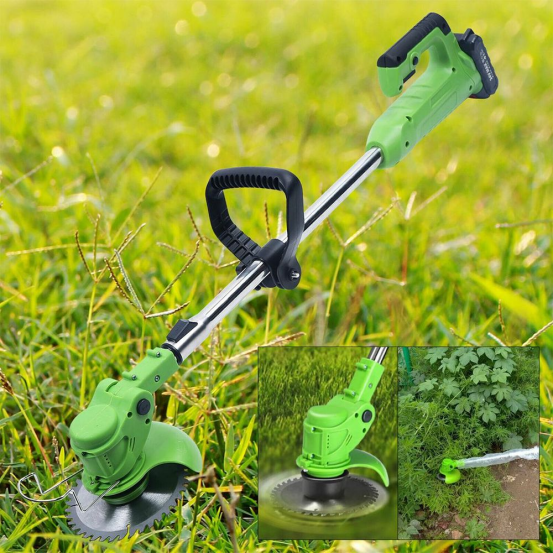
It’s not about buying the most expensive model—it’s about matching specs to terrain. Based on maintaining more than a dozen challenging lawns, here are the three core standards every mower for tough terrain should meet:
1. Power Output: Minimum 1500W, Blade Speed Over 3000 RPM
Slopes often grow thicker, tougher grass due to uneven sunlight and soil moisture. Underpowered motors can’t keep up, causing constant jams and even motor burnout.
What to look for: Mowers with at least 1500–2000W motors and a blade speed of 3000+ RPM. The 1600W Electric Lawn Mower runs at 3300 RPM and easily cuts through half-centimeter-thick weeds in one pass.
Avoid: Low-power models (≤1200W). In my trials, a 1000W mower jammed within minutes and overheated after just one slope.
Real-world benefit: With the 1600W unit, Mark now mows his 15-degree slope continuously, without stalling or overheating, cutting his yard time in half.
2. Stability: Low Center of Gravity and Wide Wheelbase
The biggest risk on slopes isn’t the grass—it’s losing control of the mower. A low center of gravity keeps the machine steady, while wide wheels reduce the chance of sliding sideways.
Specs to check: Deck height of ≤30 cm and wheelbase ≥25 cm. The 1600W model has a 28 cm deck and 27 cm wheelbase, making downhill pushes smooth and predictable.
What to avoid: Narrow, bicycle-like wheels or tall, lightweight frames that tip easily. I once tested a slim cordless trimmer on a slope—it slid sideways within seconds.
User experience: Reviews on the shop page confirm this: “Wide enough wheelbase to handle my 15-degree slope safely,” one buyer reported.
3. Cutting Width: 300–350mm for Tight Corners and Irregular Yards
Oversized decks save time on wide-open lawns but become a headache in tighter spaces. The sweet spot for most irregular lawns is 300–350mm.
Why it matters: The 1600W mower’s 330mm deck fits neatly between flower beds, trims corners without repeated repositioning, and still covers ground efficiently.
Flexibility: Choose 350mm for open yards with fewer obstacles, or 300–330mm for smaller, corner-heavy lawns.
Case in point: Mark’s yard has three awkward corners. With the 330mm model, he finishes 15 minutes faster than with his old 400mm deck, with no missed patches.
Maintenance Tips to Extend the Life of Your Mower
Buying the right mower is only half the battle. Regular care ensures it keeps working season after season. Here are three essential habits:
Clean Blades and Wheels After Every Use
Grass clippings wrap tightly around blades, especially after slope mowing. Always disconnect power, brush along blade edges, and wipe with a damp cloth. Mud also collects around wheels—scrape it off to prevent axle wear. The 1600W’s rubber wheels hold up well against repeated cleaning compared to plastic wheels.
Mow Across Slopes, Not Up or Down
Push the mower horizontally across inclines rather than diagonally or straight up. This evens out motor stress and reduces sliding. Maintain a steady pace of one step per second—fast enough for efficient cutting, slow enough to prevent stalling.
Store Upright and Keep Dry
Never store a mower flat—it can warp wheels. The 1600W model includes an upright stand, perfect for garage corners. Wipe down after use, especially if morning dew is present, and avoid damp basements that can cause motor corrosion.
How to Quickly Find the Right Mower on the Shop Page
If you’re browsing the full electric mower collection, here’s a 30-second filtering method to pinpoint slope- and irregular-lawn-friendly models:
Filter by power: Enter “1500W–2000W” in the search bar to eliminate weak models.
Filter by cutting width: Choose 300–330mm for tighter yards, 350mm for open lawns.
Read real reviews: Scroll to the bottom of product pages and look for mentions of slopes or uneven lawns. These insights are more reliable than ad copy.
Still unsure? Start with the tested and proven 1600W Electric Lawn Mower. With strong power, stable design, and a flexible cutting width, it’s one of the most versatile solutions for American homeowners.
Final Thoughts: The Right Mower Turns Difficult Lawns into Easy Work
Mark now mows his slope in just over an hour, without back strain or equipment failure. The secret isn’t high-tech gimmicks—it’s matching the mower’s specs to the lawn’s challenges.
For slopes and irregular lawns, remember the three pillars: power, stability, and maneuverability. Choose with these in mind, and mowing goes from exhausting chore to manageable routine.
If your yard has slopes, tricky corners, or uneven ground, check out the full collection of electric lawn mowers. Or share your yard’s layout in the comments—slope angle, obstacles, or size—and let’s find the best-fit machine together.
What’s the toughest mowing challenge you’ve faced? How did you overcome it? Your story might help another homeowner finally tame their “impossible” lawn.